


Next: Solution to Exercise 8.31.
Up: No Title
Previous: Solution to Exercise 8.28.
Again, I have to criticize the author's language.
Since 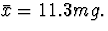 , the data do ``indicate''
that the average daily zinc intake falls below the
recommended amount of 15 mg. Do they offer strong
evidence that it falls below 15? Now that's a
question for statistical hypothesis testing. So,
letting
, the data do ``indicate''
that the average daily zinc intake falls below the
recommended amount of 15 mg. Do they offer strong
evidence that it falls below 15? Now that's a
question for statistical hypothesis testing. So,
letting  denote the population mean of zinc
intake (in mg./day) for men 65-74, we will test
denote the population mean of zinc
intake (in mg./day) for men 65-74, we will test

The sample size n = 115 is quite sufficient to
allow us to use a z-test (generally  is considered acceptable), so

Clearly signficant. We reject for small values of
z. At the .05 level, we reject for z < -1.645,
so clearly we can reject at the .05 level of significance.
From the table in the book, we have
P[Z < -3.49] = 0.0002, so we know that we can
reject at any level of significance above 0.0002.
In fact, the P-value is about  .
.
Dennis Cox
3/31/2001